Built on WIX Headless

Aerospace & Security

Explores ethical issues linked to space, defense, security, and dual-use technologies. It analyzes surveillance, autonomous systems, strategic intelligence, conflict, protection of human life, and emerging risks, seeking to frame aerospace and security innovation through responsibility, proportionality, and human dignity.

Aerospace & Security

Attack drones, autonomy and lethal decision-making: the Portuguese case and the ethical limits of technological warfare.

Loitering munitions make a decisive tension visible: technology can increase precision, but it can also distance the human agent from the moral decision to kill. The ethical question is not merely whether the weapon is effective or legal, but whether it preserves real human judgment, clear responsibility, and democratic limits on lethal force.

8 min de lecturaMiguel Vieira

Aerospace & Security

Health data, privacy, and consent: the autonomy lost when data starts circulating.

Health data are not merely information: they are sensitive fragments of the person. Their secondary use can improve research, public policy, and clinical innovation, but it requires privacy, understandable consent, fiduciary governance, and continuous transparency. Without post-consent autonomy, technical data protection may coexist with the ethical loss of the person.

11 min de lecturaMiguel Vieira

Aerospace & Security

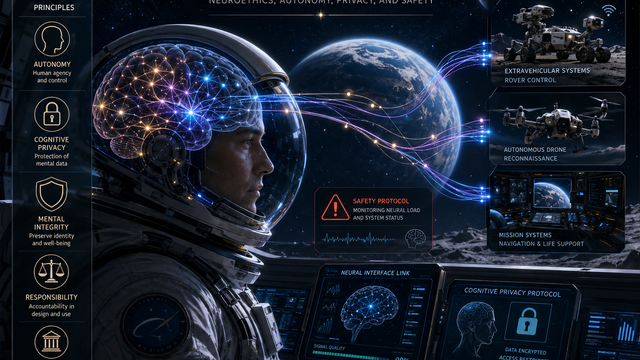
Brain–Computer Interfaces in Space Exploration: Technological Integration, Mission Advantages,and Ethical-Legal Implications

Brain–Computer Interfaces (BCIs) hold transformative potential for human space exploration, offering novel solutions for enhanced astronaut performance, communication, and safety. This paper critically examines the technological integration of BCIs within the demanding context of space missions, systematically identifying and addressing epistemic gaps related to empirical validation, philosophical and neuroethical implications, and regulatory frameworks. By analyzing speculative application scen

19 min de lecturaSheila Torquato Humphreys